
Knowledge Blog · Print technologies

Why printhead geometry belongs in the selection decision
Two label printers with the same resolution, similar data sheet figures and comparable price levels can produce visibly different results on the same material. On coated paper the gap barely shows. On woven tape, on uncoated paper, or on a barcode with narrow bar widths, it becomes a quality assurance topic soon enough.
The cause is rarely the electronics or the resolution. It is the geometry of the printhead, which data sheets often reduce to a single keyword: flat head or near edge. Anyone specifying a system decides with that one line on substrate suitability, consumables, printhead life and running costs.
Research the question, though, and most of what turns up mixes label printers with systems that print directly onto packaging film. Thermal transfer overprinting, or TTO, means printing directly onto flexible packaging materials inside the packaging machine. Different speeds apply there, different materials, different boundary conditions. Carrying figures from that world across to a label printer reliably produces the wrong expectations.
This article therefore stays with label printing throughout. NOVEXX Solutions uses both geometries in its own label printers and can name both sides of each: the strengths and the limits.
Flat head and near edge: the difference is the contact zone
In thermal transfer printing, a heated printhead transfers ink from a ribbon onto the label material. To do so the head carries a heater line, a row of individually addressable heating elements that build the image one dot column at a time. Both geometries work on this principle. What differs is where the heater line sits and how the head is angled towards the material.
That determines the contact zone: the distance over which ribbon and label stay pressed together after the heating point before they separate. This distance governs how long the applied heat keeps working. It is the real distinction, and nearly every other difference follows from it.
Flat head: heat input with continued contact
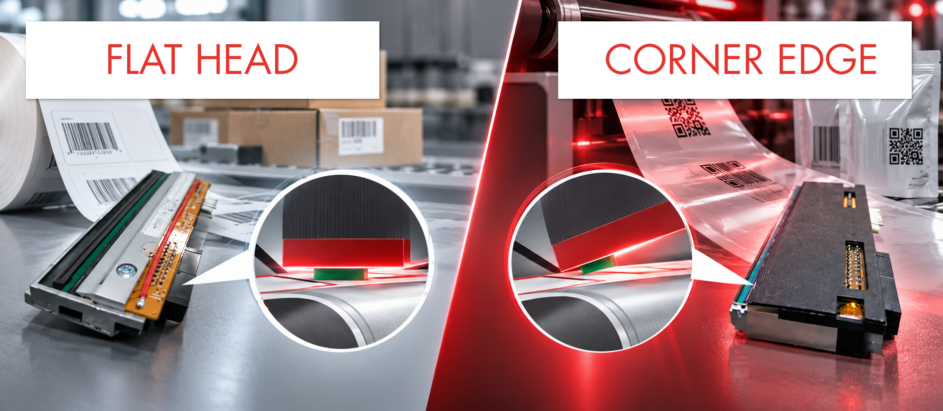
With a flat head printhead the head lies flat and parallel to ribbon and label, and the heater line sits inside the flat contact area. After the heating point, ribbon and label travel on together for a distance on the order of a few millimeters before the ribbon is pulled away.
That continued contact is not a side effect, it is functional. The ink stays warm and under pressure for longer, it can work into the surface, and only then does it set. On materials that draw heat away quickly or have an open, absorbent structure — textiles being the clearest example — that can be the decisive advantage.
Near edge: heat input with immediate separation
With a near edge printhead the heater line sits on the edge of the printhead and the head is angled towards the material. Ribbon and label separate immediately behind the heating point, and the contact zone is on the order of tenths of a millimeter.
This geometry has a second consequence that the shape alone does not reveal. Because the heat-storing material at the edge occupies a very small volume, the head stores less heat and responds faster: it heats up briskly and cools down briskly. That is precisely why this geometry belongs where high print speeds and clean contours have to come together.
Near edge, corner edge, floating head: a question of naming
In practice you will meet several terms for the same thing. Near edge, corner edge and occasionally floating head are used largely interchangeably in the market. The technical literature draws finer distinctions according to whether the heating dots sit on the edge, on the corner of the edge, or near it. For an application decision none of that matters, because the advantages and limits are practically identical. Where this article says near edge, the same applies to corner edge.
What the contact zone does to the printed image
Where flat head leads: difficult surfaces and high energy demand
Some materials need more than ink placed on top of them — the ink has to get into the material. Textile carriers are the clearest example. For print on woven material to survive washing, the ink layer has to melt far enough to reach between the fibers and anchor there. That takes time under heat and pressure, and continued contact under a flat head is what supplies it.
This assessment rests on the experience of NOVEXX Solutions in development, manufacturing and service: more than 50 years with labeling systems and more than 35 years with thermal transfer printing, including machine variants built specifically for textile identification.
Where near edge leads: edge definition, speed and code quality
Where heat input stops at once, the ink stops spreading. Contours stay tightly bounded, fine lines and small type stay separate. Combined with the fast thermal response of the head, the image stays precise even at high speed. Because it stays stable across a wider range of speeds, print speed can also follow the speed of the conveyor – the prerequisite for systems that match their labeling to a varying belt speed.
For identification that is more than a matter of appearance. Barcode quality is assessed by measurement, among other things through contrast, modulation and defects, as set out in the international standard series on barcode print quality. A bar edge that has bled degrades exactly those parameters. Where narrow bar widths, small two-dimensional codes and high throughput meet, the argument favors near edge.
Standards
Measured assessment is set out in ISO/IEC 15416 for linear barcodes and in ISO/IEC 15415 for two-dimensional symbols. Which standard in which edition applies, and which quality grade is binding, depends on industry, application standard and trading partner, and has to be checked case by case.
Ribbon and material: what the geometry means for consumables
Because contact times differ, the ink has to release from its carrier at different rates. Ribbons are therefore formulated for one geometry; what matters is the release layer between carrier film and ink, which governs how the ink lets go. A ribbon designed for the slower release under a flat head will not deliver the same result in a near edge machine, and the reverse holds too.
A second point concerns quantity. Under a flat head the ribbon normally advances in proportion to the label material, whether or not anything is being printed. The angled geometry makes it possible to lift the head quickly across unprinted sections and hold the ribbon still. What that means for cost belongs in the next section.
Printhead life and running costs: separately for each print method
Blanket statements about service life mislead on this topic, because they leave out the print method. Thermal transfer and direct thermal printing load the head in very different ways. In direct thermal printing there is no ribbon: the material carries a heat-sensitive coating and is blackened directly. That also removes the sliding layer the ribbon would otherwise provide between head and material.
Thermal transfer printing: markedly longer life with near edge
In thermal transfer printing, near edge printheads reach a markedly longer service life than flat head printheads. The reason lies in the same geometry that shapes the printed image: shorter contact time, less sustained thermal load, and a head that can cool between print operations.
For running costs that is the deciding factor. A near edge printhead can be more expensive to buy than a flat head, and the print unit built around it is more elaborate, which also shows in the price. The service life advantage clearly outweighs both, but only across the full operating life and in proportion to print volume: where a lot of material passes through, running costs are usually lower; where a machine prints very little, near edge stays the more expensive option. Add the option of holding the ribbon still across unprinted sections and the picture shifts further in the same direction.
Direct thermal printing: different rules apply here
In direct thermal printing the starting point reverses. Without a ribbon the head rubs directly on the material surface, and with the angled near edge geometry the edge meets that surface especially directly. Combined with rough direct thermal materials, wear can progress faster than in thermal transfer printing. For this application a printhead with a reinforced protective layer is the right choice.
That shrinks the structural cost advantage flat head starts with in direct thermal printing to a small remainder. And there is one case in which it tips over entirely: as soon as labels are not printed across their full area, the angled head can be lifted over the unprinted sections and stops rubbing across the material needlessly. The same mechanism that saves ribbon in thermal transfer printing protects the printhead in direct thermal printing — with correspondingly longer life and usually lower total costs.
Maintenance: cost per interval against length of interval
Maintenance costs deserve a second look, because two quantities are easily confused. The individual maintenance or cleaning package is usually cheaper on a flat head machine. It does, however, tend to come due after considerably fewer running meters. Across the operating life, near edge leads on total cost, particularly once cleaning effort is counted in.
So count intervals in running meters, not in years. On the calendar the two machines can look similar, because near edge systems typically sit where far more material passes through. What is being compared is then not the same thing.
What the geometry does not decide
Some of the properties attributed to head geometry in comparisons actually belong to the machine. Whether a head can lift across unprinted sections, whether contact pressure adapts to material thickness, how the material is guided, which resolutions are available: those are design and control decisions taken by the manufacturer. The geometry makes some of them possible; it guarantees none of them.
For selection that means checking these points machine by machine rather than technology by technology. The question is not whether near edge can adapt contact pressure, but whether the specific machine does.
How to read print speed figures on a data sheet
Few figures get compared out of context as often as print speed. A number on its own says little, because it depends on conditions the data sheet rarely prints beside it. Four questions take you further.
- At which resolution does the figure apply? As resolution rises, achievable speed usually falls.
- On which material and with which ribbon was it established? Coated paper with a wax ribbon is a different case from synthetic material with a resin ribbon.
- By which criterion does the result count as good? A visible printed image is not the same as a barcode assessed against a test standard.
- Does the figure refer to a label printer or to a TTO application? Values from direct printing onto packaging do not transfer directly to label printing.
The last point is the most common error. A figure may reasonably be based on what the drive can achieve, or on the result that stays reliably readable across common consumables. Both are legitimate reference points; they simply produce very different numbers. NOVEXX Solutions specifies conservatively by choice, which means against the reliably readable result across a broad range of materials. So when comparing data sheets, ask about the conditions rather than only about the maximum. Or have a print test run with your material and your label layout. Get in touch through the contact form at the end of this page, and we will work out together which samples, data and conditions the test needs.
Two lines, two decisions
A clothing manufacturer marks care labels on woven tape. The requirement is wash resistance, volumes are moderate, codes are on the larger side. Energy input is what counts here, because the ink has to reach the fiber. A flat head machine is the obvious choice, and a resin-rich ribbon goes with it.
A distribution center labels shipping cartons in flow, with a system integrated into the conveyor line. The requirement is throughput with reliably readable codes, the material is coated paper, and the labels are often only partly printed. Speed, edge definition and printhead life count here, along with the option of reducing ribbon consumption and head wear across the unprinted areas. Near edge is the better fit.
Selection criteria at a glance
The comparison below sorts tendencies, not scores. It helps with the shortlist; the decision is made on the actual material with the actual ribbon.
| Criterion | Flat head | Near edge |
|---|---|---|
| Contact zone and heat input | a few millimeters in order of magnitude; heat keeps working afterwards | tenths of a millimeter; heat input ends with separation |
| Surfaces that are hard to print | ahead, for example on woven material and uncoated paper | limited, depending on material and ribbon |
| Ribbon | formulated for flat-lying heads | formulated for angled heads |
| Edge definition and speed | sufficient for most label applications | ahead, particularly with narrow bar widths and high throughput |
| Printhead life in thermal transfer printing | the reference point of the comparison | markedly longer |
| Behavior in direct thermal printing | robust; individual printhead cheaper | reinforced protective layer advisable; ahead where labels are not printed across their full area |
| Maintenance | individual interval usually cheaper, but usually after less running length | longer intervals, usually cheaper across the operating life |
Table 1: the two printhead geometries compared against seven selection criteria.
Both technologies from one source
Most manufacturers commit to one geometry and then explain why it is the right one. NOVEXX Solutions uses both in its own label printers: the XLP 51x with a flat head printhead and the XLP 604 with a near edge printhead. The machine family around the XLP 60x has been built on near edge technology for several generations.
The practical value for you is this: the recommendation does not have to fit the technology on hand, it has to fit the application. Where woven tape calls for a flat head, or where quality and volume requirements are modest, the answer is flat head. Where throughput and code quality set the tone, it is near edge.
Conservative specification is part of the same approach. Figures are chosen so that they are achievable across a broad range of materials with readable print. That produces values which look unremarkable in a data sheet comparison — and which hold up in production.
For printheads with a reinforced protective layer in direct thermal printing there is no standard market designation; they are named partly by function, partly by construction. When in doubt, ask for the printhead for direct thermal applications.
In summary
The difference between flat head and near edge comes down to one quantity: the contact zone between heating point and separation. Substrate suitability, consumables, edge definition, printhead life and running costs all follow from it. Neither geometry is generally superior to the other. So selection follows an order: material and quality requirement first, then the print method, then the machine. Work in that order and the decision is made once rather than several times.
Next step
You know which material you have to mark, but not which geometry fits it? Put the material combination, the code requirement and the volume profile together — the choice usually emerges in a single conversation. Talk your application through with NOVEXX Solutions.
Frequently asked questions
Is near edge simply the better technology?
No. Near edge leads on speed, edge definition and service life in thermal transfer printing. Flat head is superior where a lot of energy has to reach the surface, as with textile carriers, uncoated papers or specialized ribbons. The right geometry follows from material and quality requirement, not from a general ranking.
Can I use any thermal transfer ribbon in a near edge printer?
No. Ribbons are formulated for one geometry, because the ink has to release from the carrier at different rates. Check which geometry a ribbon is approved for.
Which geometry gives the longer printhead life?
In thermal transfer printing, near edge, and by a clear margin. Shorter contact time and lower sustained load act directly on service life. Direct thermal printing is a different case, because the ribbon is not there as a sliding layer; a head with a reinforced protective layer is advisable. Where labels are not printed across their full area, near edge can lead there too.
Why are some print speed figures lower than on comparable machines?
Because figures are arrived at in different ways. A value may be based on what the drive can achieve, or on the result that stays reliably readable across a broad range of materials. Ask about resolution, material, ribbon and quality criterion. Without those, you are comparing numbers rather than performance.
Is near edge suitable for direct thermal printing?
Yes, with the right equipment. Without a ribbon the head rubs directly on the material, which is why a printhead with a reinforced protective layer is recommended. Where labels are only partly printed, lifting the head reduces wear further.