
The short answer:
Labels land in the same place every time when the system knows how fast the product is actually moving. Ideally the distance between product sensor and dispensing edge is held in millimeters, and the controller derives the start delay from it. Work from a fixed speed value or a fixed delay in milliseconds, and the label shifts with every deviation. A rotary encoder on the conveyor supplies the information needed to compensate — at NOVEXX Solutions the function is called APSF.
11. August 2026, written by Max Graf, Product Manager at NOVEXX Solutions
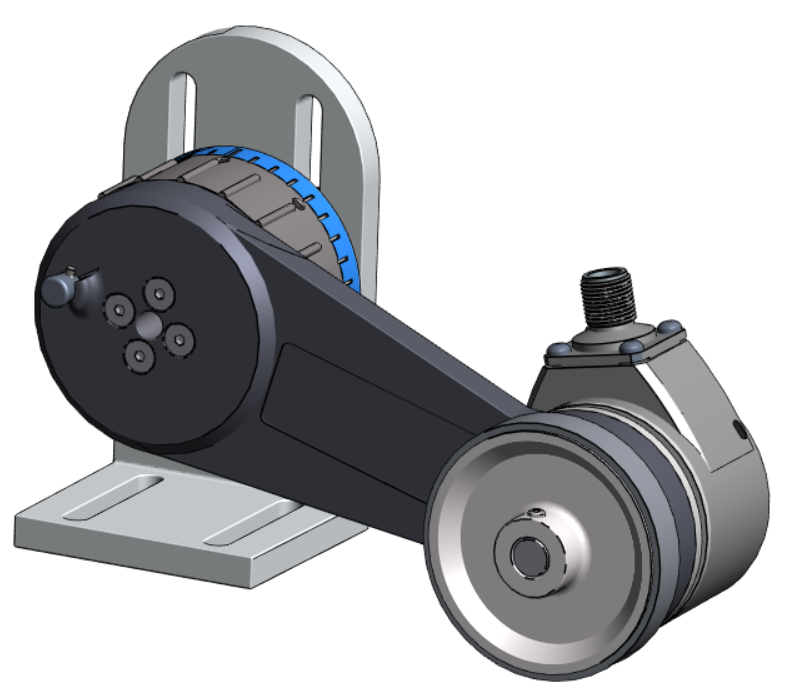
Rotary encoder with measuring wheel and bracket for mounting on the conveyor
Table of contents:
Why a correctly set up label still drifts
What actually determines label position
A fixed speed value or a measured one
Three situations where this matters on the line
Direct dispensing and applicator operation: a difference that counts
Requirements and limits
Where the function is available
In summary
Frequently asked questions
Why a correctly set up label still drifts
The line is set up, the label sits exactly where it should during the trial run, and in production it moves anyway. A few millimeters forward, a few millimeters back on the next order. Re-adjusting treats the symptom: the setting was never wrong, it simply matched an operating state that has since changed.
What changed, in most cases, is the speed of the conveyor. It varies as the line starts up and runs down, it follows the rhythm of upstream machinery, and it is deliberately altered for a different product. For labeling this is not a side issue. It is the quantity that label position depends on directly.
What actually determines label position
The sequence is the same in every automatic labeling process. A product sensor, usually a photoelectric sensor, detects the product at a defined point along the conveyor and issues a start signal. The controller waits for a set period. It then dispenses the label at the dispensing edge, the edge where the label is separated from the liner and handed over to the product.
What matters is how that waiting period is arrived at. Ideally the distance between product sensor and dispensing edge is entered as a physical distance in millimeters — on NOVEXX Solutions systems it appears as the start offset. A distance can be measured on the machine, which keeps the entered value open to a plausibility check at any time. Simple controllers, of the kind found in self-built labeling stations, often accept only a delay in milliseconds. That figure has to be derived from distance and speed first, and it is hard to retrace later.
Both input methods share the same weakness: the stored value is fixed. A distance only becomes a waiting period by way of the speed at which the product travels, and a delay in milliseconds fits exactly one speed to begin with. Once the actual speed differs from the assumed one, the waiting period is wrong — however precise the mechanics may be.
A fixed speed value or a measured one
Without speed following, the controller works from a stored figure: in direct dispensing mode, the print and dispensing speed that has been set. If the conveyor runs slower than that figure, the calculated waiting period is too short, the label is dispensed too early and sits too far forward. If it runs faster, the position shifts the other way. The error scales with distance: the further the product sensor sits from the dispensing edge, the more a speed deviation shows.
Automatic speed following replaces the assumption with a measurement. A rotary encoder on the conveyor — a sensor that converts belt movement into electrical pulses — reports continuously how fast the product is actually traveling. The start delay is calculated from that live value instead of from one entered once. At NOVEXX Solutions the function is called APSF, Automatic Product Speed Following.
The difference is less a matter of convenience than of where errors can enter. A fixed value requires the conveyor to keep to the specification. A measured value does not.
Three situations where this matters on the line
As a line starts up and runs down, the first and last products travel slower than the nominal speed the system was set up for. Without speed following it is precisely those labels that end up offset — and with short batches or frequent restarts that accounts for a considerable share of production. With it, the system works from the real speed from the first product onwards.
Where products and processes change, belt speed often changes from order to order. Working from a fixed value makes re-adjusting the labeling parameters part of every changeover. Measuring removes that step: the start delay follows the new speed by itself.
If the line stops while a label is being dispensed, belt and label feed run out together. The feed stops and is reactivated automatically when the belt restarts. For quality management this is the real point: labeling accuracy is maintained during production without anyone intervening — and therefore without the scatter that manual re-adjustment inevitably introduces.
Direct dispensing and applicator operation: a difference that counts
In direct dispensing the dispensing edge hands the label straight to the passing product. Print speed, dispensing speed and belt speed are ideally synchronized in this mode, so speed following acts on two quantities at once: when the label is dispensed, and how fast it is printed. The second also matters because print speed can affect print quality, particularly with finely resolved content such as 2D codes.
Applicator operation works differently. An applicator is an assembly that takes the label from the dispensing edge and applies it to the product by a mechanism of its own; it is used where direct labeling is not possible. Printing and dispensing are decoupled from product movement here. Speed following acts on the start delay instead — on when the applicator fires — and so bridges the distance between the trigger sensor and the application point even when conveyor speed changes.
Requirements and limits
A rotary encoder on the conveyor is required. It is not part of the machine’s scope of delivery, and it need not be a special component: standard industrial encoders with a 24 volt signal are suitable, provided the pulse resolution matches the application. NOVEXX Solutions offers a matching encoder type with brackets and cables as an accessory. Depending on the installation it is mounted with a measuring wheel running on the belt, on the drive shaft, or directly on the motor shaft.
On NOVEXX Solutions print modules and print & apply systems an interface board is needed for the connection. The board is fitted ex works or can be retrofitted later, which keeps the function available for existing installations. On the XLS series labelers it is included as standard.
One limit applies to direct dispensing only. Because print speed follows belt speed there, print quality can suffer on a very slow line. A minimum speed can be set on print modules and print & apply systems, below which the system will not print. Positional accuracy is then slightly lower, but still better than with a fixed value throughout. In applicator operation the trade-off does not arise, since printing and application are separate anyway. Speed following and RFID encoding cannot be used at the same time on print modules and print & apply systems.
Where the function is available
On labelers, automatic matching of dispensing speed to belt speed is an established feature; the XLS 2xx labeling systems carry it as standard. On print & apply systems it is considered less often, even though the coupling of print and dispensing speed is an additional argument for it there. It is available on the XPA 9xx series and on the XDM/XPM 94x OEM print modules, covering the XDM and XPM 944, 945 and 946 models, where the final digit denotes print width.
XPA series systems use a corner edge printhead, which matters for print quality at varying speeds.
In summary
Label position is the result of a calculation, and a speed value sits inside that calculation. Assume it, and position is only as stable as the conveyor. Measure it, and the variation loses its effect. The question when specifying a system is therefore not whether conveyor speed varies, but whether the system gets to know about it.
Want to know how this would work on your line?
Talk to us and we will go through what your conveyor needs to bring to it.
Frequently asked questions