
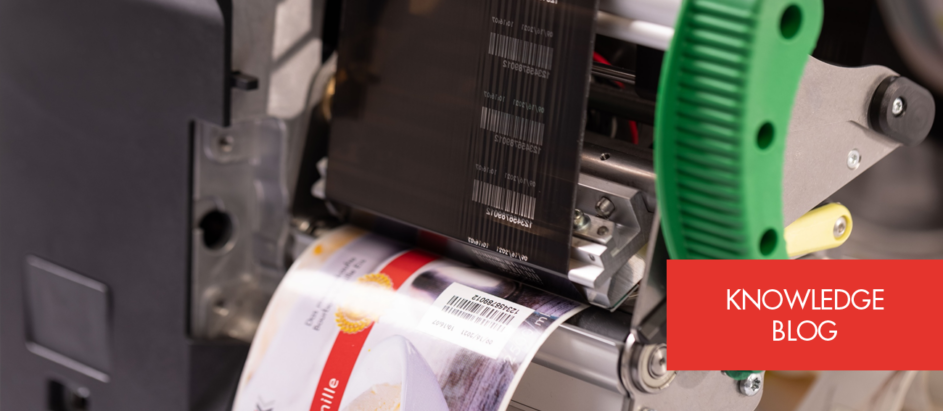
Knowledge Blog · Printing technologies

The method decision is not really about the printer
Companies defining a labeling application settle the printing method early, and usually on consumable cost per label. That calculation is understandable, but it is incomplete. It leaves out how long the label has to stay readable, what it will be exposed to, and how often the printhead has to be cleaned and replaced.
The mistake rarely shows up right away. It shows up when labels have faded after a few weeks in storage, when a barcode fails at the customer's receiving dock, or when a printhead dies earlier than planned. By then the method is locked in, and switching costs more than the original price difference ever saved.
This article places both methods in technical context, states their strengths and their limits, and lays out the questions that actually decide the choice.
Direct thermal and thermal transfer: the technical basics
Both methods rely on the same component: a thermal printhead. A thermal printhead is a row of individually controlled heating elements, called dots. Each dot creates one image point when it heats up. What differs between the methods is where the color comes from.
Direct thermal printing
Direct thermal printing is a method in which the label material itself reacts to heat. Its surface carries a heat-sensitive coating made up of a color former, a color developer, and a sensitizer. Wherever the printhead applies heat, those components react chemically and the image point turns black. No ribbon is involved.
How fast and how dark a direct thermal material can be printed depends on its dynamic sensitivity. Dynamic sensitivity describes how much energy per unit area — stated in millijoules per square millimeter — is needed to reach a given optical density. Materials with low sensitivity need more energy or a longer dwell time, which means lower print speed. A high energy requirement is not purely a drawback, though — it points to a coating that also responds less readily to unintended heat.
Thermal transfer printing
Thermal transfer printing is a method in which a heated printhead transfers ink from a ribbon onto the label material. The ribbon consists of a carrier film, an ink layer, and a backcoat. The printhead melts the ink layer selectively and transfers it to the label.
The ink layer defines the character of the print. Wax ribbons are economical and suited to paper labels. Wax-resin ribbons resist smudging better and cover a wider range of materials. Resin ribbons offer the highest resistance to abrasion, heat, and solvents, and belong on synthetic materials. Which grade fits depends on the label material and on the exposure the label will face in service — not on the printer.
The real difference: one layer between head and label
From the equipment's point of view, the most important difference is not the ink but the ribbon itself. In thermal transfer printing it runs between printhead and label material and keeps the two apart. In direct thermal printing, the printhead sits directly on the chemically reactive coating of the label — and in practice that coating almost always sits on paper. Paper is considerably more abrasive than synthetic material because of its uneven surface and its fillers, and direct thermal applications choose paper especially often, usually on cost grounds.
That single layer explains much of what follows: printhead life, contamination, and cleaning effort. It also explains why finished labels behave differently. In direct thermal printing the color chemistry stays in the label permanently and can keep reacting later. In thermal transfer printing it is only involved during printing; afterward the ink sits on the label as a finished layer.
Five questions that decide the choice
In practice, these five questions get you to a defensible decision faster than a feature comparison.
- How long does the label need to stay readable, and what happens if it does not?
- What will it be exposed to — heat, light, moisture, grease, solvents, abrasion?
- What material should the label be made of: paper, coated paper, or a particular synthetic?
- What code quality is required, and is it verified?
- What matters more on your line: maximum throughput, or as few interruptions as possible?
As a rule of thumb: for label lives of days to weeks, with no particular exposure, on paper, direct thermal is the cheaper option on consumables. As soon as one of the exposures applies, synthetic material is involved, or readability has to hold for months, the answer moves to thermal transfer.
The case for direct thermal
Direct thermal has real strengths that comparisons tend to shortchange. Almost all of them sit in operations rather than in the print image.
- One consumable only. There is no ribbon to order, store, load, or match. That shortens changeover times and removes a source of operator error.
- No ribbon waste. Spent ribbon and cores never accumulate. That is a genuine environmental advantage, though it sits opposite the environmental drawbacks of the heat-sensitive coating.
- Lower material cost. Blank thermal paper in standard sizes is inexpensive and widely available. One caveat matters: quality varies considerably at the low end of the market, and an inadequate coating costs more later than it saves at purchase.
- Simpler operation. The question of which ribbon suits which material disappears — one less thing for operators to get wrong.
- A clear advantage for short label life at high volume: shipping and transport labels, temporary stock and shelf identification, or weigh-scale labels.
The case for thermal transfer
The strengths of thermal transfer sit almost entirely in the result and in component life.
- A far wider material range. Beyond plain paper, you can print coated papers, synthetic films such as PP, PE, and PET, and specialty materials. Labels can also be pre-printed to your own design.
- Resistances you can select on purpose. Ribbon grade lets you target abrasion, heat, solvent, and weather resistance deliberately, and colored and certified grades are available for regulated applications.
- Longer printhead life. The ribbon separates the printhead from the label material, and a well-matched pairing needs less energy. Both spare the head.
- Less contamination. Heat-sensitive coatings leave more residue on the printhead than a ribbon does, so cleaning effort is correspondingly lower in thermal transfer operation.
- No delayed discoloration. The label carries no reactive coating that can change later under heat or light.
- Higher achievable speeds — but only with a matched material combination; see the next section.
On the most common objection: the ribbon change
Ribbon changes are widely treated as a drawback of thermal transfer. In practice, most of that objection dissolves once roll lengths are matched to each other. One ribbon roll then covers several label rolls, so that ribbon and label changes fall together. Current print-and-apply systems take ribbon rolls of more than 1,000 meters, which corresponds to several full label rolls. Ribbon-save functions stretch the interval further.
The time involved is therefore minor: the label change takes the larger share anyway, and the ribbon only joins it every few label rolls. Cleaning effort weighs more heavily, since direct thermal operation calls for shorter cleaning intervals — and that downtime adds up faster than any ribbon change. The thermal printhead — what really determines its service life
Speed is a material question
Print speed is usually attributed to the method. In fact it follows from how label material, ribbon, and printhead work together.
In direct thermal printing, the paper's dynamic sensitivity is the ceiling. If it is not enough for the speed you want, two options remain: print slower, or put in more energy. The second option loads the printhead further and sharpens the very weakness the method already has. Specified top speeds in direct thermal printing are correspondingly lower than those of a well-matched thermal transfer combination.
In thermal transfer printing the ceiling sits higher, and it depends heavily on the label material: broadly speaking, maximum speeds are lowest on uncoated paper, higher on coated paper, and highest on synthetic labels.
So if you need high speeds, look at the application as a whole rather than at the printing method alone.
Durability: why direct thermal labels age
A direct thermal label carries a coating that reacts to heat. In the printer that property is the point; in the field it is a risk, because the reaction cannot be confined to the print event. Heat, light, moisture, fats and oils, plasticizers migrating out of plastics, and solvents can all alter the image after printing — it fades, or the whole label darkens.
What this means in practice: it is not only the print that can disappear. The contrast between bar and space can also drop far enough that a barcode no longer scans reliably. That is what makes the damage expensive, because it surfaces at the recipient rather than in your own production.
Material manufacturers tie image durability explicitly to their storage and handling instructions. Anyone running direct thermal should know those instructions and measure their own process chain against them: storage temperature, sunlight, contact with packaging films and cleaning agents.
Thermal transfer does not raise the question in the same way. The ink sits on the label as a melted layer and does not continue to react chemically. How resistant it is comes down to ribbon grade — and that can be chosen to match the application.
Health and the environment
Direct thermal coatings need a color developer. For decades that was predominantly bisphenol A, whose use in thermal paper has been restricted in the European Union since 2020. Bisphenol-free alternatives largely resolve the human-health question but partly relocate it: the most widely used phenol-free color developer is not classified as hazardous to human health, yet it is assessed as hazardous to aquatic environments. There is no simple better or worse here.
Thermal transfer sidesteps the discussion because the label needs no chemically reactive developer. In exchange it generates waste in the form of spent ribbon — but inside your own production, where it is known and can be disposed of deliberately. With direct thermal, the question spreads across a great many end points: labels are rarely separated from the product before disposal, and in markets without a developed recycling system that is nearly impossible to steer. An honest environmental comparison therefore also asks whether a problem actually gets smaller — or merely moves.
Media pairing: the most common avoidable failure
Choosing the method is the first step. The second one decides the result: matching consumables and equipment. Thermal transfer adds one variable — the ribbon — that has to be chosen correctly once. Everything else applies equally to both methods: label surface, printhead type, energy setting, and speed all have to fit together. With direct thermal the effort merely shifts, away from a one-time material selection and toward daily operation. Shorter printhead life makes cleaning routines, spare-parts stocking, and contingency plans more important. You choose the ribbon once; you need the service continuously.
One point gets overlooked regularly: ribbons are not freely interchangeable between printhead designs. Flat-head and corner-edge or near-edge printheads need differently formulated ribbons, because contact time and cooling behavior differ. Printhead design is therefore a selection criterion for the consumable, not just a feature of the machine. Flat head and corner edge – printhead geometry compared
When the pairing is wrong, the symptoms repeat: weak contrast despite increased energy, ragged edges and the falling code quality that follows 2D code quality in thermal transfer printing, poor smudge resistance, residue on the printhead, and premature wear. These symptoms are frequently blamed on the machine when they originate in the consumable.
That leads to an inconvenient but practical recommendation: buy consumables by released combination, not by price per roll. And when in doubt, test rather than estimate — with the actual material, the actual substrate, and the actual line speed.
Matching the label to the product
Beyond print image and durability, it is worth looking at the label material relative to the packaging. A paper label on paper or carton packaging, and a synthetic label of a comparable polymer on plastic packaging, make sorting in recycling easier because fewer material mixes arise.
At the same time, material similarity often improves the resilience of the finished product, because the drawbacks of a material mix are avoided. For applications with environmental targets, label materials containing recycled content are also available.
For the method decision this means: if the label material has to be a synthetic for recycling or durability reasons, the decision is effectively already made in most cases. Direct thermal depends on heat-sensitive coated materials, while thermal transfer covers the full range of available label materials.
Conclusion
Direct thermal and thermal transfer are not competitors; they are answers to different requirements. Direct thermal is the leaner solution for short-lived identification on labels. Thermal transfer is the choice as soon as any further requirement or expectation attaches to the label.
The decision that really matters, though, sits one level down. Both methods only perform as well as consumables and equipment suit each other and the application. Deciding by unit price instead of quality can simply move cost into failures, complaints, and printhead replacements.
Next step
If you are unsure whether your intended label and ribbon combination suits the application, talk to our specialists. NOVEXX Solutions supplies thermal transfer ribbons and custom labels, and helps you make the selection. product page for labels and thermal transfer ribbons When in doubt, we have the combination tested rather than estimated.
Frequently asked questions
What do I gain by switching from direct thermal to thermal transfer?
Mainly durability and material freedom. The print no longer changes under heat or light, resistance to abrasion, heat, and solvents can be targeted through ribbon grade, and a wide range of synthetic materials becomes available alongside paper. The ribbon also protects the printhead and reduces residue, which lowers cleaning effort and the risk of unplanned downtime.
When is switching from thermal transfer to direct thermal worthwhile?
When labels are short-lived, printed on paper, and not exposed to anything demanding — typical of shipping, transport, and temporary stock labels. Then lower material cost, one consumable instead of two, and shorter changeovers argue for the switch. The condition is a coating quality that suits both the machine and the required speed.
When is direct thermal the wrong choice?
When the label has to stay readable over the long term, or faces heat, sunlight, moisture, fats, plasticizers, or solvents, or when you need access to a wider range of label materials. It is also risky wherever code quality is verified over a longer service life, because contrast can drop after printing. In those cases thermal transfer is the more dependable choice.
Why does the printhead last shorter in direct thermal operation?
Because the ribbon is missing — the layer that separates printhead and label in thermal transfer printing. The head therefore contacts the chemically reactive coating directly, more residue is left behind, and the required energy input is often higher. All three effects add load to the heating elements. How large the difference turns out to be depends on material, speed, and how clean the environment is.
Is direct thermal cheaper because no ribbon is needed?
Per label, usually yes; across the life cycle and on a total-cost basis, not necessarily. The calculation has to include printhead replacements, cleaning effort, downtime, and the downstream cost of unreadable labels at the recipient. Which side wins is decided by how long the label has to stay readable.
Which method is the better choice for health and the environment?
There is no blanket answer. Direct thermal coatings need a color developer; bisphenol A has been restricted in thermal paper in the EU since 2020, and bisphenol-free alternatives shift part of the question toward water protection. Thermal transfer avoids the reactive coating but generates ribbon waste in production — where it stays controlled. A sound comparison also looks at how the labeled product is disposed of at the customer.